
Green Tomato: “Best Choice” and “Good Alternative” Seafood Options Swell
Friday, 10 January 2014 17:24
 As U.S. fisheries rebound under strict federal management, more species earn Seafood Watch “green” and “yellow” rankings. Meanwhile, shrimp caught in Louisiana waters remains on the “Avoid” list.
U.S. fisheries are rebuilding under tough management regulations required under federal law. One sign of success: the growing number of seafood items that have earned a “Best Choice” or “Good Alternative” recommendation from the Monterey Bay Aquarium Seafood Watch program.
In 2013 alone, red snapper from the Gulf of Mexico, monkfish and trap-caught black sea bass from the East Coast, and many Atlantic flatfishes have been upgraded, based on new data in the peer-reviewed science reports that underpin all Seafood Watch recommendations.
Today, 95% of the 242 most commercially important U.S. fishery species assessed by Seafood Watch are rated either green (Best Choice) or yellow (Good Alternative). The percentage is based on total landings in ports on the West Coast, Gulf Coast, Atlantic seaboard and in the Great Lakes.
Seafood Watch recently upgraded U.S.-caught red snapper in the Gulf of Mexico to a “Good Alternative” recommendation because sound management has helped once-depleted populations recover. Trap-caught black sea bass from the South Atlantic was also upgraded to a “Best Choice” recommendation.
 The Lexington College Board of Directors recently announced the appointment of Professor Kelly O’Leary as president of Lexington College. For the past three years, O’Leary has served on the faculty in the Hospitality Management Department. Since July, she has served as vice president of the college.
 Not every chef who steps into the kitchen is ready for the challenge of competition in front of the camera. New England Culinary Institute graduate Sean Quinn (’01) recently beat out the competition on Food Network’s culinary-competition show, “Chopped.” Quinn is also a graduate of C-CAP (Careers through Culinary Arts Program), designed to prepare high-school students for college and career opportunities in the hospitality industry. The scholarship he received through C-CAP allowed him to attend New England Culinary Institute and eventually led him to become executive chef at Chadwick’s in Brooklyn, N.Y., where he has been for seven years.
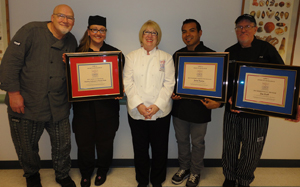 The American Personal & Private Chef Association (APPCA) recently honored four chefs with Awards of Excellence at the 2013 APPCA Personal Chef Summit at Stratford University in Baltimore.
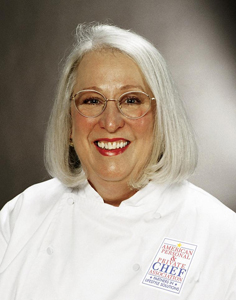 Why culinary teachers should consider operating a personal-chef business as an adjunct career. It’s not only for the additional income.
 At this year’s Worlds of Flavor Conference at the CIA in the Napa Valley, presenting chefs from the best kitchens in Western Europe, Asia, Latin America and the United States stressed developing a sense of place in one’s cuisine.
 Annual dinner for national foodservice media, prepared by students, recognizes an exemplary professional U.S. culinary-arts program.
  Several foodservice educators contributed to the American Culinary Federation’s chef team’s second-place win among 12 teams in Dubai.
 Chef Jason Ziobrowski of InHarvest inspires culinary grads of Victory Trade School.