

New Technology Series: Induction Cooktops
31 March 2026Induction cooking offers safer, sustainable and more efficient stovetop options.
By Lisa Parrish, GMC Editor
Jack Campbell, Kendall College Chef Instructor and Asst. Professor
Feedback & comments: This email address is being protected from spambots. You need JavaScript enabled to view it.
The large, gas-burning cooktop under the massive hood has been a professional kitchen’s focal point for many years. Cooks watch multiple plans, sweating in the excess heat of the burners, furiously finishing one order while another pan heats up for the next ticket.
Is all this about to change? New technology has a way of doing just that. Although relatively new in the current kitchen scene, induction cooking has been around for a long time. It was first widely introduced at the World’s Fair in Chicago in 1933, received a boost in popularity around 1950 from General Motors’ Frigidaire division, and even NASA employed the technology for the space program. Induction cooking transfers electromagnetic energy from the induction top directly to pots and pans, not the cooking surface itself, offering speed and precision with environmental and health benefits.
Adoption of induction cooking is taking off in Europe followed closely by the Asia-Pacific region, driven by a demand for time- and energy-efficient cooking solutions. The US has been much slower to integrate the technology, although some high-end operations such as the French Laundry in Napa Valley, Calif, and Dirt Candy in New York, NY, are on board. US pastry chefs are leading the way in adoption stats as they prefer the new technology for its precise temperature controls.
Commercial induction cooktops are available from manufacturers such as Winco and CookTek Induction Systems. Although they may be expensive to purchase, the single burner units are portable, don’t require a hood and use either a 120-volt or 240-volt outlet. The burners conduct heat through stainless steel and cast iron pans. By heating the pans directly, there is minimal energy loss, making induction cooking more energy efficient. With approximately 90% efficiency, induction cooking surpasses the roughly 74% efficiency of traditional electric stoves and 40% of gas stoves, demonstrating significant energy savings.
Read Kendall College Chef Instructor Jack Campbell’s article as he discusses how he incorporates induction cooktop technology in lessons across Kendall’s culinary curriculum. 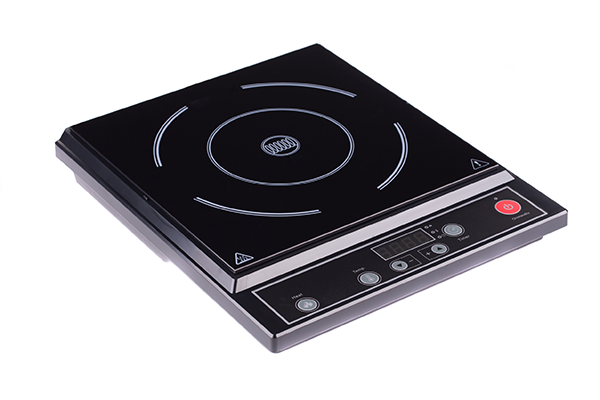
Getting ahead of the induction cooktop’s learning curve.
By Chef Jack Campbell
Induction Cooktops have been around since the early 1900s. They did not become popular until the 1970s and that was primarily in private homes, not commercial applications. It wasn’t until the late 1980s and early 1990s that it became more widely used in the commercial sector.
Induction cooktops work using electromagnetic waves produced by a magnetic coil and transferred to a cooking vessel that turns the large amperage of energy into heat. The coil is typically placed under a glass or ceramic surface that allows electromagnetic waves to easily pass through. They are also easier to clean. The cooking vessel must be ferrous. Ferrous pots and pans are magnetic and react to the electromagnetic field that is produced by the induction coil. Non-ferrous pans (like aluminum) will not work. The pan/pot must be physically on the glass surface for it to start. The glass surface does not heat up at all, but it does become hot due to the heat created from the pot. Under the glass surface, a thermometer gauges the temperature of the pot. This is one of the great advantages of induction cooking – precise cooking temperatures. The cooktop can be set to 175 degrees F for a consistent simmer. This can be very difficult with a gas cooktop.
There are other advantages to induction cooking. One is the efficiency factor. Gas cooktops do not use all of the energy to heat pots or pans. With gas, much of the heat goes up and around the pan, being lost and inefficient. All the energy created from the induction process goes into the pot material and is transferred to the food inside. A side benefit of this is the ability to heat the product faster. Boiling water can take half the time to come to a boil with induction as opposed to gas heat.
Another advantage is that there is less chance of scorching liquids, thick sauces, broths and chocolate. Since gas heats up the sides of a pot and induction only heats the bottom, there is a reduced chance of sauces cooking, scorching or burning. This is a great advantage when reducing sauces, tempering chocolate and reducing sugar for candy recipes.
Induction cooking does not produce VOCs, the dangerous fumes produced by gas combustion. Because of this they do not require ventilation. They also do not produce excess heat. This means cooler kitchens and less waste of energy.
 Strong student outcomes
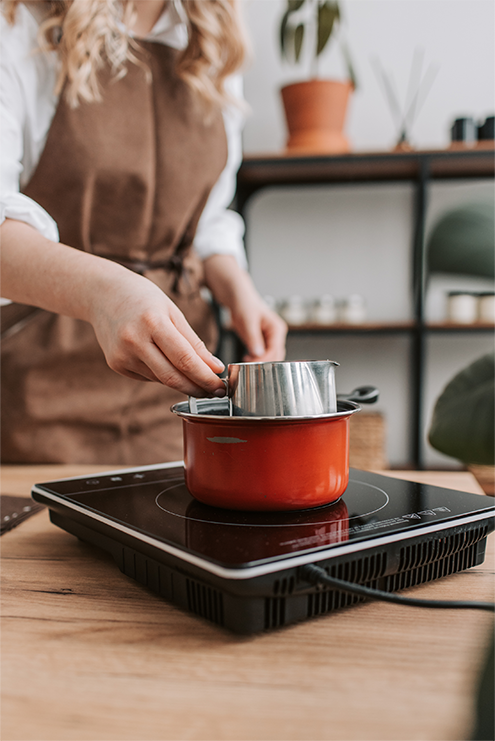
Students gain powerful knowledge when utilizing induction cooktops for precise cooking. This is a definite plus in the Food Science and Baking and Pastry classes. Without the use of the induction cooktops, many recipes can be harder to produce with variable results. For example, when using gas burners, students can vary their heat production from burner to burner. All induction cooktops have the same variable amount of heat and are extremely precise. This allows for more consistency from student to student. Induction burners remove the inconsistencies inherent in cooking with gas burners.
The adaptation of the new equipment better prepares our students for professional foodservice, even though the technology is not yet widely used in the industry. When our students land a professional cooking job with a gas stove, they may have an additional learning curve.
Induction cooking has the potential to shape the future
Induction cooking’s potential can soon be a huge factor. Some municipalities, including New York City, are restricting the use of gas in commercial buildings and private residences. There are also restaurants that have chosen to go all electric for environmental reasons, which means they need to use induction cooktops. Two all-electric restaurants are Alinea Restaurant here in Chicago and the French Laundry in California. The restaurants choose induction cooking for environmental reasons and the technology’s precise cooking features. Because of just these two factors, there will be more restaurants solely using induction cooking. This puts our students at an advantage when they graduate. In fact, most of the Baking and Pastry program students cook with induction cooking.
Changing culinary teaching methods
Teaching with induction cooking can be challenging. One difficulty is that sauteing is not very efficient. The pan is moved and taken off the burner while cooking but that severs the electromagnetic connection. We are now teaching students new sauteing techniques on the induction cooktops. It can take a few tries but once they learn this skill they will be able to carry it with them. It is another “tool” the students have that makes them better cooks.
Cost-saving technology
Adding induction cooktops can save money. One of the highest saving aspects is that it does not require ventilation. There are still some food odors that are best ventilated, but they do not require powerful hood systems. Another savings comes when the amount of energy consumed is so much less - for example, it can boil water in less than half the time of a gas stove. Even with electricity rates being higher, when one considers the amount used and factors in the cost of the wasted gas, the technology can have cost-saving benefits.
Students are more marketable understanding new technologies
Induction cooking is a relatively new experience for many of our students, and it benefits them to learn it in culinary school. We feel it is another advantage that best prepares our students for entry into the industry.