
Culinology Match Test
Sunday, 31 May 2009 20:05
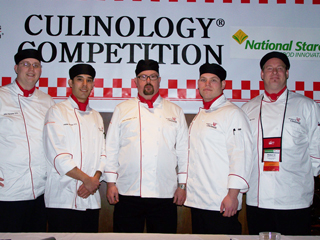 The third-annual Student Culinology® Competition at RCA’s 2009 conference exemplified the blending of culinary art and food science.
An enthusiastic student team from University of Cincinnati took first-place honors, along with a $5,000 cash award and industry-wide recognition as rising stars in food-product development, at the third-annual Student Culinology® Competition, May/June 7, during the Research Chefs Association’s (RCA) 2009 conference at the Sheraton Dallas Hotel. The award was presented by Agnes Jones, principal culinologist at National Starch Food Innovation, at the 2009 RCA Annual Luncheon, where nearly 500 food-product-development professionals gather each year to celebrate industry achievements.
The competition is designed to challenge and recognize the industry’s young talent in the Culinology field–the blending of culinary arts and food science.
The winning team from UC was led by faculty advisor Christopher Keegan, CEC, senior research chef at Cargill Flavor Systems, and team leader Christian A. Serrato, CC. Team members included Robert Coltrane, CC, John Parsons, CC, and Andrew Scholle, CC.
 Crossword and word-search puzzles can be fun, effective tools for familiarizing students with important terms.
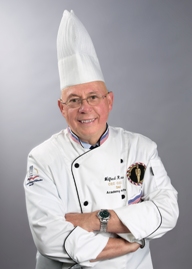 Center-of-the-plate proteins, including American lamb, are the focus of this lesson plan for freshman in the Associate of Applied Science degree program at Southern Maine Community College in South Portland. The course, of which this lesson is a part, addresses the basic fabrication of meat, fish and poultry; stocks; the five major sauces; derivative sauces; coulis, jus lié, and reductions. The class covers moist and dry methods of cooking that demonstrate appropriate cooking methods for a wide array of products.
 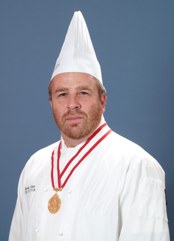 As the demographic of culinary schools shifts to a much more multicultural environment, embracing and celebrating cultural diversity is becoming part of the everyday life of culinary institutions. The challenge for culinary instructors is in finding a way to integrate cultural diversity into the curriculum in a tacit manner, one in which students might not recognize the true objectives, yet at the same time, achieve a sense of accomplishment and pride in their own cultural heritage and cuisine.